
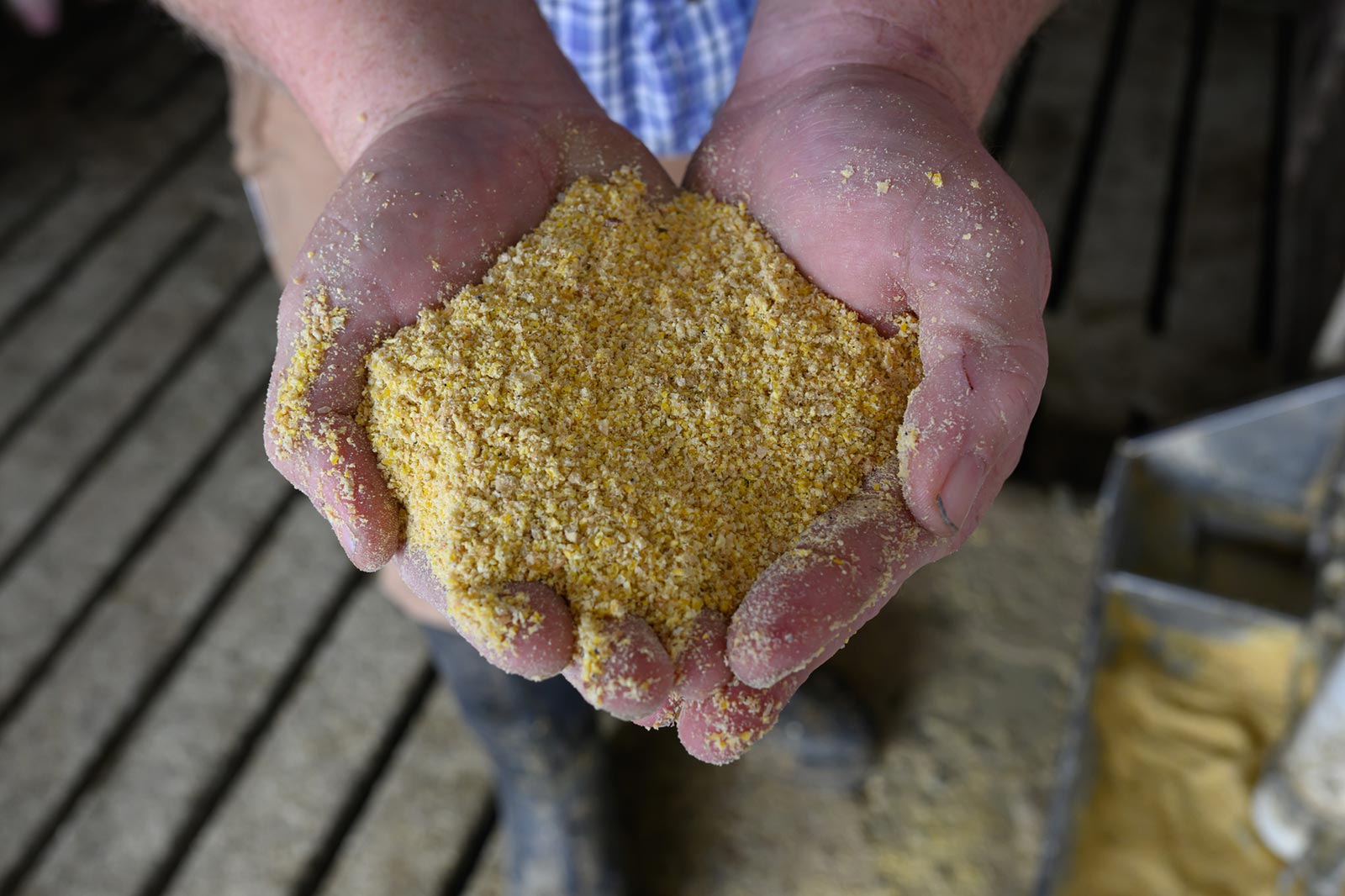
Soybean meal may meet a feed mill’s specifications for crude protein but still fail to deliver the nutritional value expected by a nutritionist. That disconnect is at the heart of the challenge Dominique Bureau, Ph.D., professor at the University of Guelph, sees in evaluating soybean and soybean meal quality.
Identifying damage becomes more difficult once soybeans are processed into soybean meal.
With whole soybeans, buyers can see differences in color, size and physical damage. During processing, however, beans are dehulled, flaked, heat treated, oil is extracted and the remaining material is ground into meal. Thus, many of the visible indicators disappear.
In Bureau’s example, the poorer-quality Brazilian beans produced meal with the highest crude protein concentration. This creates what Bureau described as the “crude protein fallacy.”
Crude protein analysis does not directly measure protein. It measures nitrogen and then uses a conversion factor to estimate crude protein. Bureau said analyses and mass-balance calculations conducted by his group suggest about 15% of nitrogen in many feed ingredients, with a range of roughly 5% to 25%, may come from compounds other than amino acids. That distinction matters because animals require available amino acids, not an analytical crude protein number.
Bureau said there is growing agreement that reactive lysine is probably the best available test for identifying heat damage because lysine is among the amino acids most sensitive to excessive heat.
However, it’s still an indirect solution. Reactive lysine focuses on one amino acid rather than the full amino acid profile, and Bureau estimated its predictive capability at roughly 60% to 70% at best.
Near-infrared spectroscopy, or NIRS, could make reactive lysine assessment more practical if robust calibrations are developed.
Most importantly, Bureau urged nutritionists to maintain some skepticism about what laboratory values actually reveal.
Crude protein remains useful as a reproducible measurement, but it should not be confused with feeding value. That principle becomes increasingly important as nutritionists formulate diets closer to animal requirements. When over-formulation is reduced, small differences in amino acid digestibility can no longer be assumed away.
Read the full article on what Bureau presented at Soy Connext 2026 here, and watch the interview below.