
An increased demand for soybeans to be grown in the Midwest, driven by a push for new soybean crushing plants could lead to a decreased cost of SBM. Lower costs and higher energy levels in SBM may lead to the replacement of corn or other energy sources such as DDGS. The inclusion rate of soybean meal (SBM) may have different effects on performance and nutrient output of manure in wean-to-finish pigs.
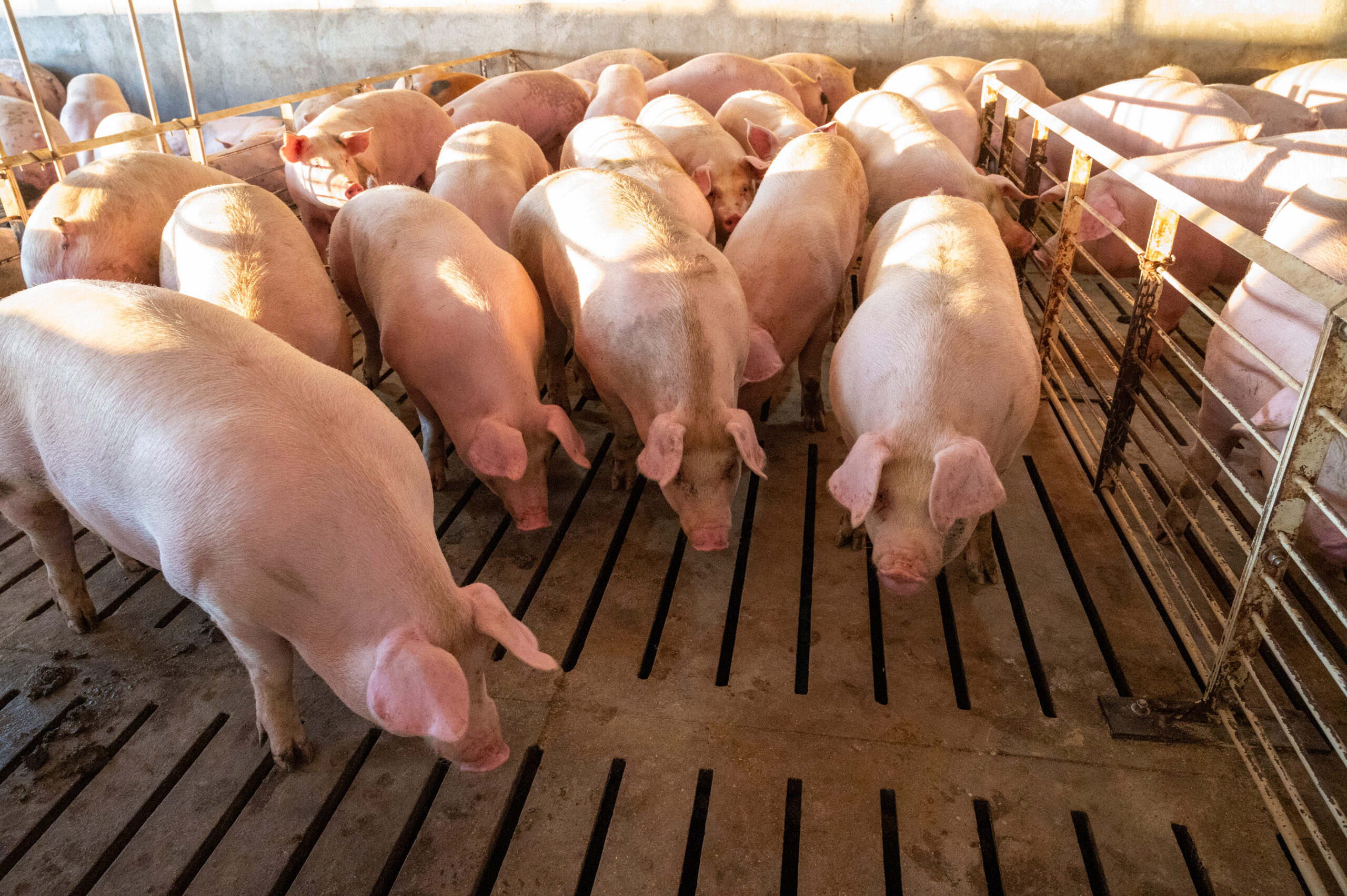
Objective: To assess the effects of feeding high and low SBM levels in pelleted diets on pig performance, carcass characteristics and total tract digestibility. A total of 275 pigs (PIC X Terminal Duroc, 12.8 kg, 7 weeks of age) were housed in a fully slatted floor, environmentally controlled room. Individual pig body weights (BW) were measured along with average daily feed intake (ADFI) every two weeks for the first 11 weeks, and then three weeks for the final weight. The treatments consisted of: 1) Corn-SBM-cDDGS diet containing 20% SBM; 2) Corn-SBM diet containing 50% SBM. SBM replaced cDDGS and corn. high (50%) and low (20%). The diets were formulated to meet or exceed NRC levels (2012). NE estimates for SBM were 2,502 Kcal/kg and for corn 2,672 Kcal/kg. The two diets were allotted to 46 pens (23 pens/diet), with six pigs per pen in a randomized complete block design. Data was analyzed using Proc GLM with pens as the experimental unit, dietary treatment as a fixed effect.
Results: Average daily gain (ADG) and average daily feed intake (ADFI) were unaffected by treatment across all phases of growth (P > 0.10). Overall gain to feed ratio (G:F) showed a tendency to be lower in pigs fed the high SBM diets (P< 0.10). Body weights were significantly higher in pigs fed the high SBM diets from week 4 to 11. 4 (P< 0.05), though no difference was observed in body weights at the final week (P >0.10). High SBM diets increased body weights in pigs through week 11. In addition, pelleting the 50% SBM diet was numerically more efficient with improved quality as compared to the control diet.
Conclusion: An overall lower G:F ratio suggests that SBM may have potential benefits when fed to pigs at higher than conventional levels. SBM can replace DDGS and corn without impacting the growth performance of wean-finish pigs. SBM can be utilized in wean-to-finish pigs in a potentially shifting economic landscape.
Halbur, J., J. Lira da Silva, R. Samuel, R. Thaler and E. Weaver. 2025. An evaluation of high and low soybean inclusion levels in pelleted diets fed to pigs from wean to finish. 2025 American Society of Animal Science Midwest Section meeting, Abstract 97.