
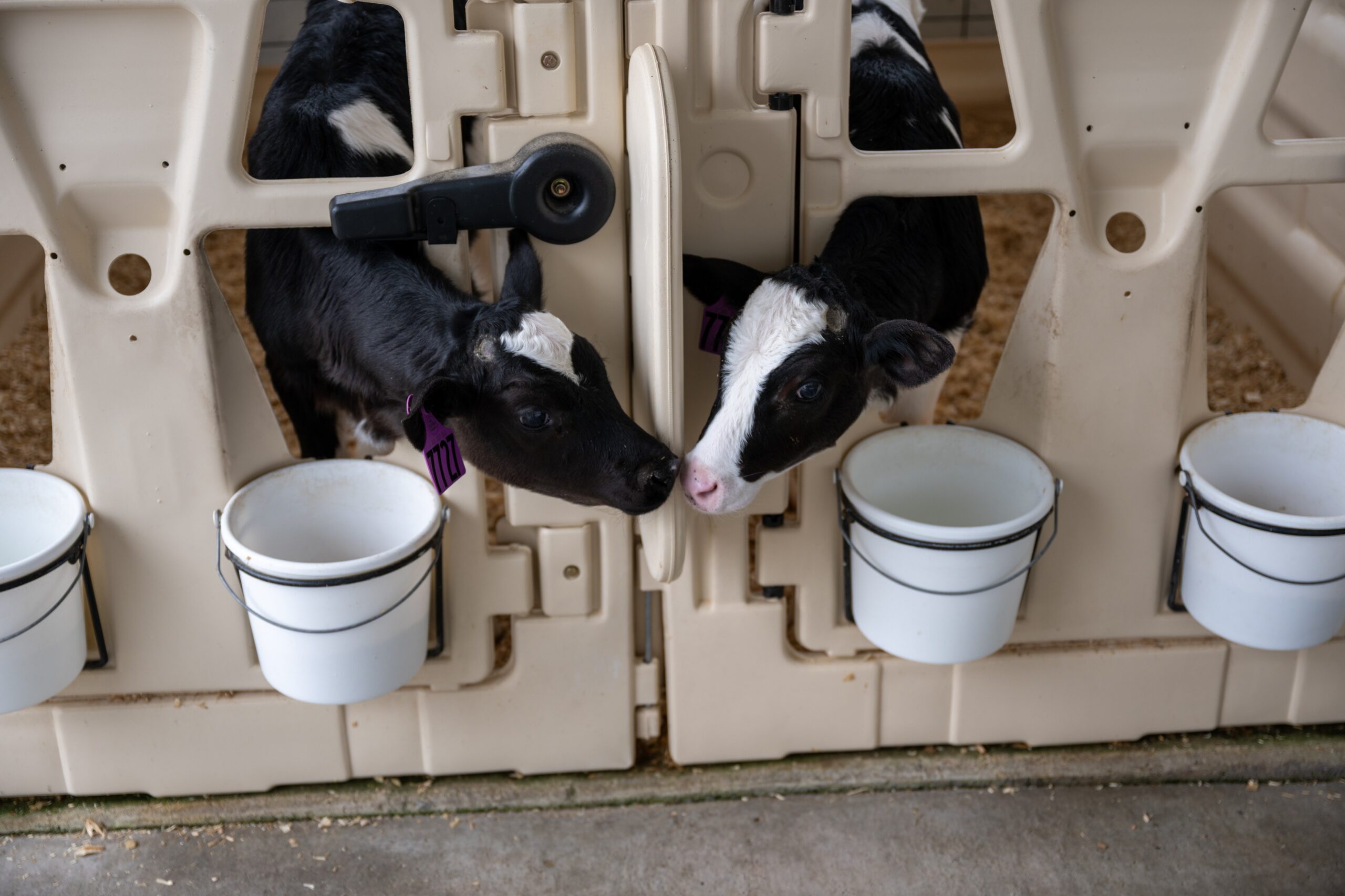
Within the past decade, the use of beef semen in the dairy industry has risen, leading to a growing number of dairy × beef crossbred calves being born. However, limited studies compare the health and growth performance of purebred dairy and crossbred calves during the preweaning phase. This study aimed to evaluate the association of breed with morbidity, mortality, and growth performance during an 84-d rearing period. A total of 640 male calves were enrolled upon arrival to a calf-rearing facility and were classified as either Holstein (n = 446) or crossbred (n = 194), which were identified by hide color. Breed, source (local farm versus auction), and BW were recorded upon arrival. Calves were fed milk replacer (MR) twice daily until weaning, which occurred between d 42 and 63, and solid feed and water were offered ad libitum throughout the study. Health exams were performed twice daily, evaluating fecal consistency from arrival to d 21 and respiratory health from arrival to d 84. Mortalities and treatments administered, including electrolytes, nonsteroidal anti-inflammatory drugs, and antibiotics, were recorded throughout the study. Solid feed intake and BW were measured weekly following enrollment, and MR refusals were recorded daily. Statistical models, including Cox proportional hazards, Weibull, negative binomial, and linear regression, were built in Stata 18 (StataCorp LP) to assess the association of breed with calf health and growth. Holstein calves had a greater incidence of diarrhea compared with crossbred calves (incidence rate ratio = 1.23; 95% CI: 1.01–1.51) and a higher hazard of receiving a second (hazard ratio [HR] = 1.62; 95% CI: 1.04 to 2.51) or third (HR = 2.47; 95% CI: 1.24 to 4.91) treatment for respiratory disease. With respect to growth performance, crossbred calves had increased BW by d 28 and weighed 7.13 ± 1.31 kg (95% CI: 4.56 to 9.70) more than Holsteins by d 84. Similarly, ADG was greater for crossbreds starting between d 28 and 35. Feed-to-gain conversion ratios (FCR) were lower for crossbred calves during both the preweaning and weaning phases; however, Holstein calves had improved FCR between d 70 and 77 compared with crossbred calves. These results suggest that crossbred calves may be able to overcome illness quicker and with fewer therapeutic interventions than Holsteins in the rearing period while achieving superior growth performance.
Read the full paper here.
Kovacs, M., D. Renaud, A. Keunen and M. Steele. 2026. Health and performance of Holstein versus dairy × beef calves: A retrospective single-cohort study. https://doi.org/10.3168/jds.2025-27748