
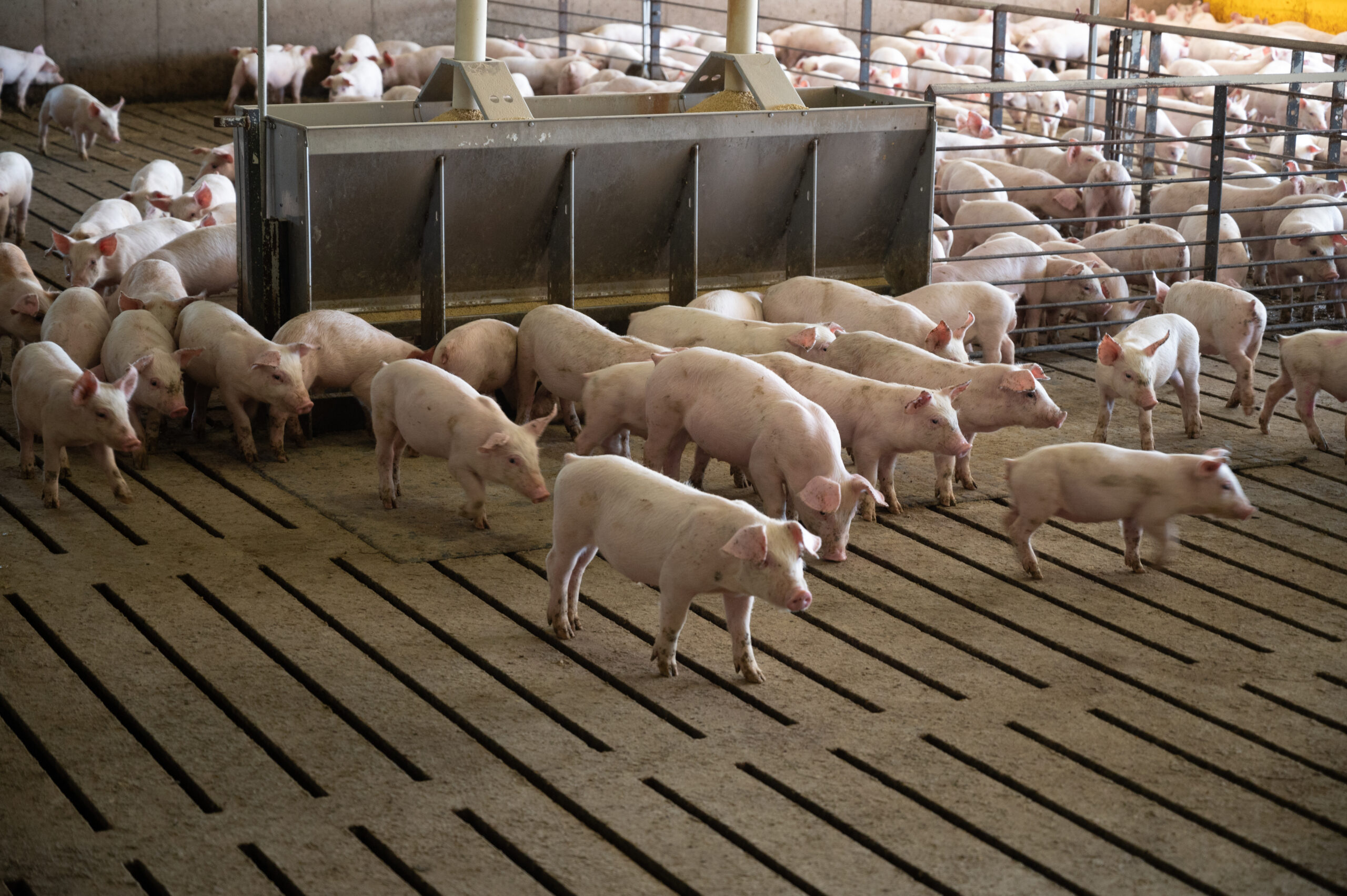
The objective was to test the hypothesis that feeding intact protein from soybean meal (SBM) to growing pigs instead of crystalline amino acids (AA) increases nitrogen (N) retention, digestible energy (DE), and metabolizable energy (ME). A control corn-SBM diet and three diets, in which the inclusion rate of SBM was reduced and 3, 4, or 5 crystalline AA (i.e., Lys, Met, Thr, Trp, Val) were added, were formulated. The concentration of standardized ileal digestible AA was constant among diets, but crude protein was reduced as crystalline AA were added. Pigs were limit fed at 3.2 times the ME requirement for maintenance. Forty pigs (initial body weight = 20.5 kg; SD = 2.4) were allotted to the 4 diets using a randomized complete block design with 2 blocks of 20 pigs with five pigs per diet in each block. Pigs were housed in metabolism crates with pans and screens that allowed for quantitative collection of feces and urine for 4 d after 5 d of adaptation. Samples of diets, feces, and urine were analyzed for gross energy (GE) and N. The statistical model included diet as fixed effect and block as random effect, and pig was the experimental unit. Contrasts coefficients were used to determine linear and quadratic effects of reducing dietary protein. Results indicated that apparent total tract digestibility (ATTD) of dry matter (DM) decreased (quadratic, P = 0.027) and ATTD of GE tended to decrease (quadratic, P = 0.076; Table 1) as SBM inclusion was reduced in the diets. Absorbed N, retained N (g/d), and ATTD of N were decreased (linear, P < 0.001) as SBM decreased in diets, but retention of N (% of intake and % of absorbed) increased (linear, P < 0.001) as SBM decreased in diets. The DE decreased (linear, P = 0.007) as SBM decreased in diets, whereas SBM had no effect on ME. Dietary SBM also had no effect on ME to GE ratio, but ME to DE increased (linear, P = 0.008) by reducing SBM in diets. In conclusion, diets containing intact protein from SBM had greater ATTD of GE and N, and greater DE, but reduced N retention rate when compared with diets containing crystalline AA. However, daily protein retention could not be maintained when crystalline AA rather than SBM were used to furnish the digestible AA in the diets, which may have negative consequences on carcass quality.
Cristobal, M., S. Lee, L. Torres-Mendoza, A. Mallea, C. Parsons, and H. Stein. 2024. PSI-15 Effect of feeding intact protein from soybean meal instead of crystalline amino acids on energy and nitrogen balance by growing pigs, Journal of Animal Science, Volume 102, Issue Supplement_2, May 2024. https://doi.org/10.1093/jas/skae102.322