
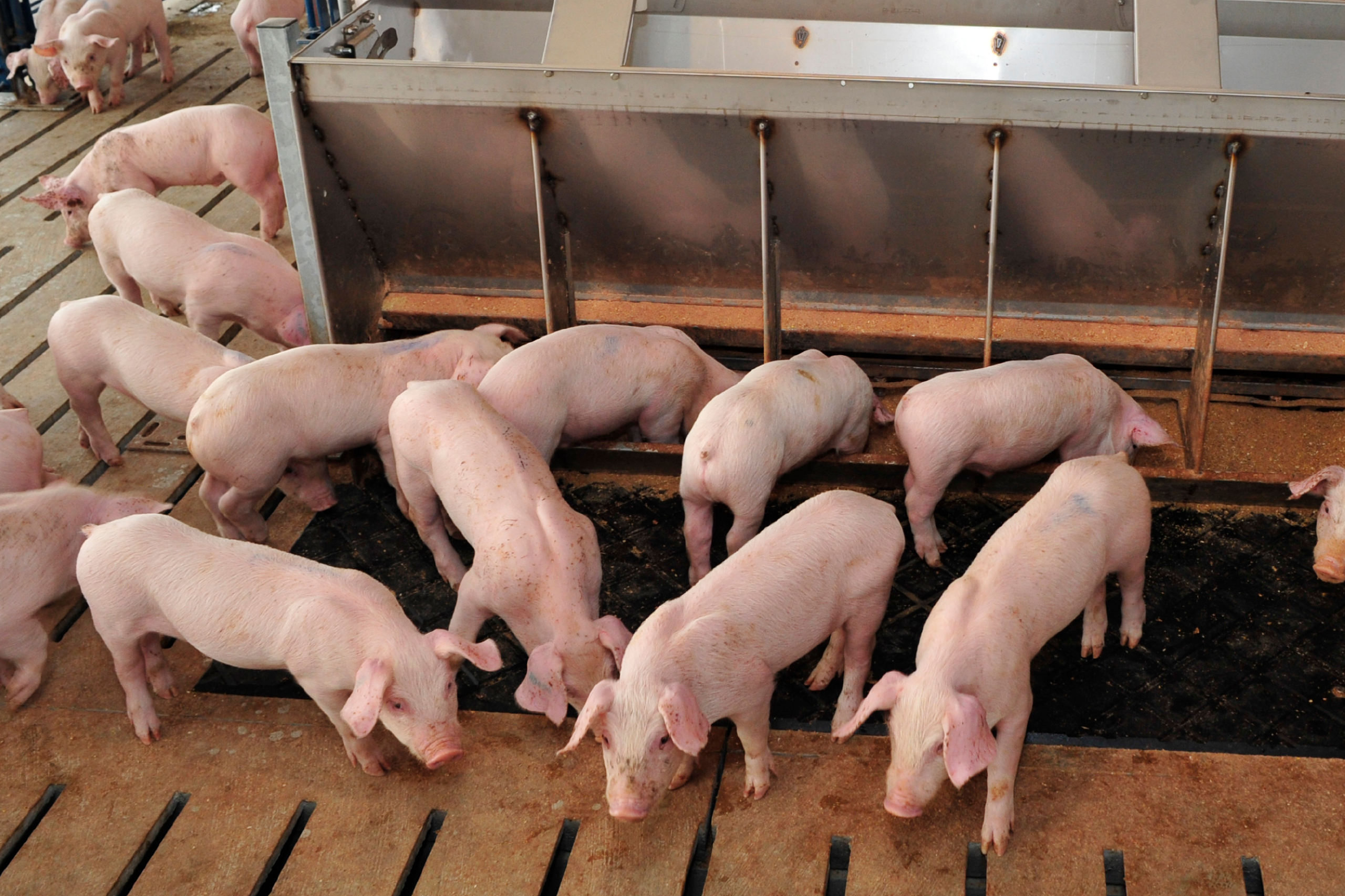
This study was conducted to evaluate the effect of increasing trypsin inhibitor (TI) levels in nursery diets on growth performance, fecal score, gut permeability parameter, and mucosal antioxidant capacity of pigs. A total of 120 newly weaned piglets (5.16 ± 1.03 kg initial body weight; weaned at 18.1 ± 1.48 d of age) were allotted to 5 treatments in 6 replicates with 4 pigs per pen based on body weight, sex, breed, and littermates for a 28-d feeding trial with two phases of d 0-14 (Phase 1) and d 14-28 (Phase 2) postweaning. Five dietary treatments were formulated to contain increasing TI levels (2.0, 3.5, 5.0, 6.5, and 8.0 TIU/mg), achieved by graded inclusion of raw soybean, except for the control diet (2.0 TIU/mg) without raw soybean inclusion. At d 28 postweaning, 6 pigs per treatment were bled for the analysis of gut permeability parameter and then sacrificed to collect intestinal mucosa samples for the analysis of antioxidant capacity. Analyzed dietary TI levels were 0.85, 2.74, 4.72, 5.59, and 8.10 TIU/mg for Phase 1 and 0.95, 2.73, 4.96, 6.04, and 7.87 TIU/mg for Phase 2. Increasing dietary TI levels linearly decreased body weight at d 28 postweaning (P < 0.05; 13.28, 12.93, 12.12, 11.44, and 10.20 kg, respectively), average daily gain (P < 0.05; 0.290, 0.278, 0.249, 0.225, and 0.180 kg/d, respectively), average daily feed intake (0.408, 0.419, 0.407, 0.396, and 0.344 kg/d, respectively), and gain-to-feed ratio (P < 0.05; 0.714, 0.669, 0.615, 0.574, and 0.521, respectively), but increased fecal score (P < 0.05; 1.37, 1.22, 1.45, 1.66, and 1.84, respectively; where 1=normal and 4=severe diarrhea) in the overall nursery period. Serum diamine oxidase levels (P=0.08; 23.15, 24.09, 21.82, 22.23, and 20.84 ng/mL, respectively) tended to decrease linearly with increasing dietary TI levels. Malondialdehyde levels tended to increase linearly in jejunal mucosa (P=0.09; 1.48, 1.25, 1.32, 1.75, and 1.43 nmol/mg protein, respectively) and had a quadratic increase in colonic mucosa (P=0.05; 1.47, 1.47, 1.30, 1.46, and 1.56 nmol/mg protein, respectively) with increasing TI levels. Superoxide dismutase activity tended to decrease linearly in jejunal mucosa (P=0.10; 11.80, 10.46, 12.65, 10.83, and 9.32 U/mg protein, respectively) and had a quadratic decrease in colonic mucosa (P < 0.05; 4.64, 5.35, 5.41, 5.86, and 4.13 U/mg protein, respectively) with increasing TI levels. In conclusion, increasing dietary TI levels negatively affected the growth performance of pigs in the overall nursery period. Dietary TI levels over 5.0 TIU/mg in the feed achieved by graded inclusion of raw soybean increased gut permeability and oxidative stress in the jejunum and colon, while reducing jejunal and colonic mucosa antioxidant capacity.
Kwon, C., J. Torres, E. Safe, J. Lee, S. Mendoza, J. Wen, S. Kim, H. Krishnan and Y. Jang. 2026. Effects of Increasing Dietary Trypsin Inhibitor Levels on Growth Performance, Fecal Score, Gut Permeability and Mucosal Antioxidant Capacity of Nursery Pigs. ASAS Midwest Section Meeting. Abstract 260. https://doi.org/10.1093/jas/skag107.211