
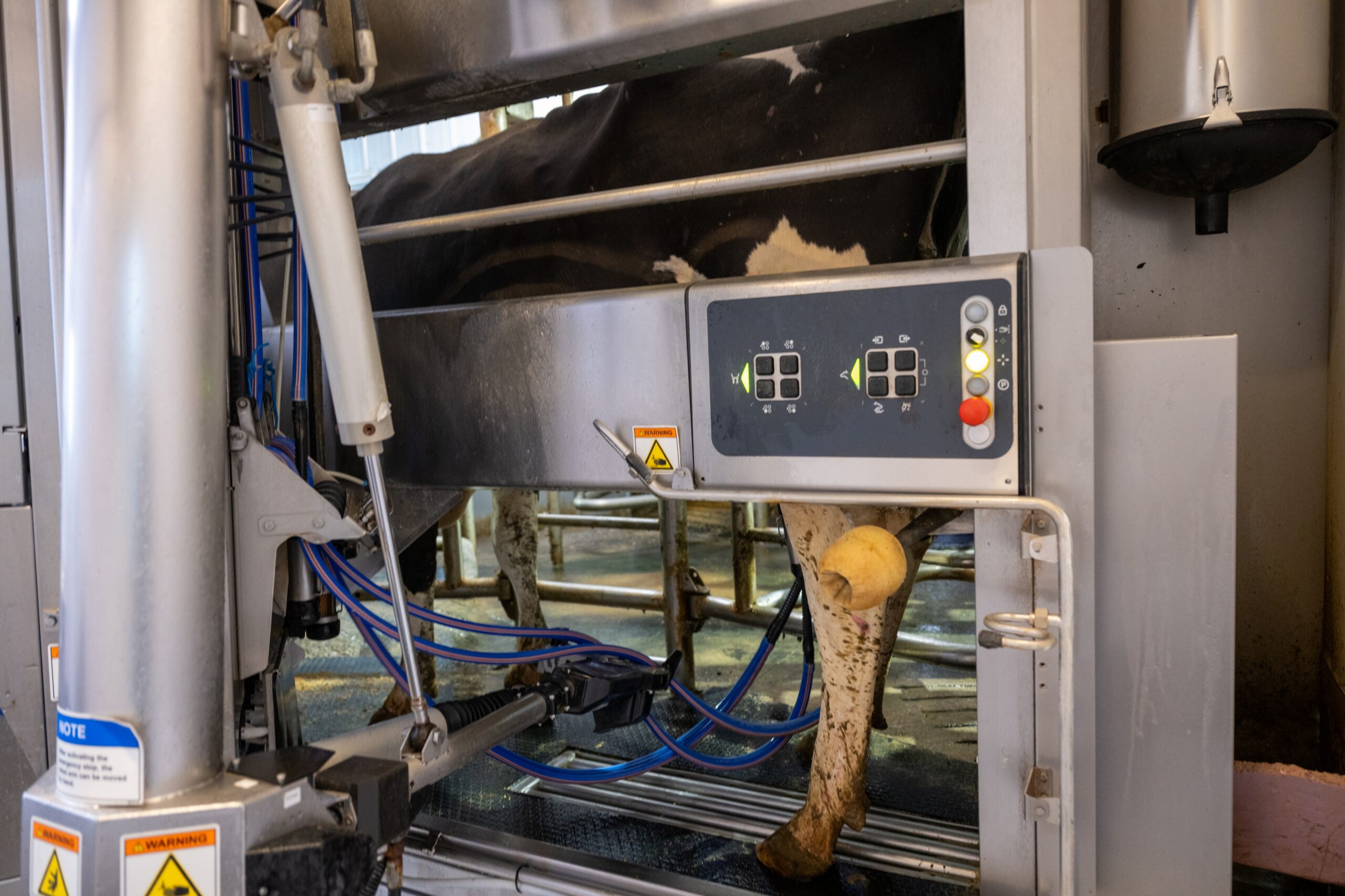
Automated milking system feeding strategies vary by farm. Cow flow, nutrition, training and management goals determine whether concentrate feeding in the milking stall can be reduced or eliminated.
The three primary motivations for eliminating automated milking stall concentrate are (1) lowering purchased feed costs, (2) eliminating less-digestible feedstuffs like wheat midds and/or (3) simplifying the system. Farms might be able to achieve these goals without completely eliminating feed in the automated milking stall. If feeding rates are less than 8 pounds per cow per day, a farm may be able to reduce purchased feed costs by using on-farm grain mixes instead of paying a mill to pellet, mix and deliver the feed. This opens the door for precision-feeding feedstuffs like roasted high-oleic soybeans (HOSB) as part of a grain mix. Farms we work with have had great success with this strategy due to HOSB’s palatability and nutrient density. However, on-farm grain mixes might not be possible for all farms, depending on farm scale and feed inventories.
Cost is only half of the profitability equation. Complete a partial budget to determine whether eliminating or minimizing automated milking system concentrate is an effective strategy for your system. Indeed, this change could reduce purchased feed costs, but it also has the potential to decrease milk production.
Read more about the 5 things to consider before eliminating automated milking system concentrate here.