
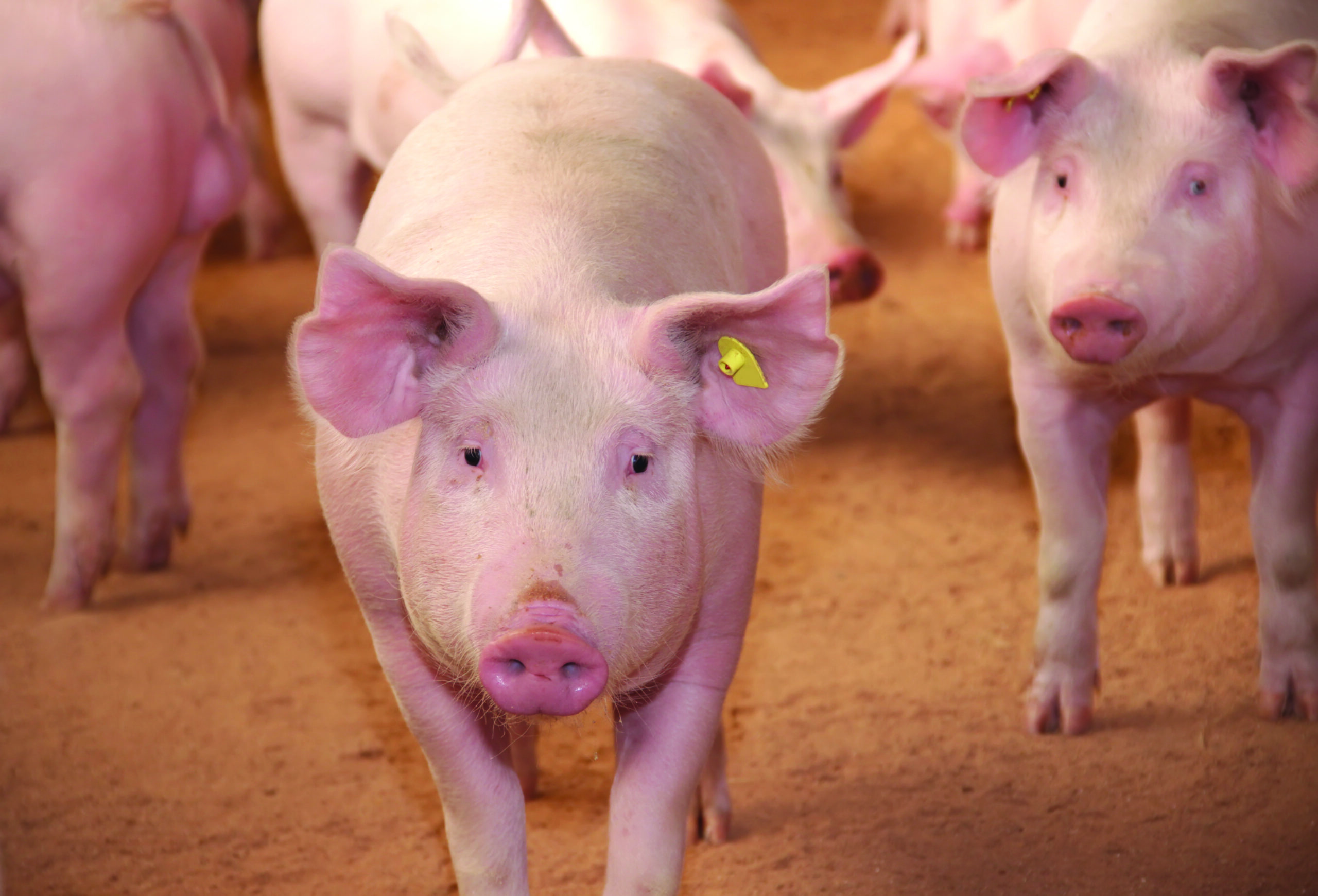
A 21-d experiment was conducted to estimate the energy value of soybean meal (SBM) and determine the effects of increasing SBM on pig performance. A total of 2,233 pigs (PIC 337 × 1050), initially 11.0 kg, were placed in pens containing 20 to 27 pigs. Treatments were assigned in a randomized complete block design with BW as blocking factor. Dietary treatments consisted of 21, 27, 33, or 39% SBM obtained by changing the amount of feed-grade amino acids and corn. There were 23 replicates per treatment. Pigs were weighed and feed disappearance measured to calculate ADG, ADFI, G:F, and caloric efficiency (CE). Cull pigs and mortality were evaluated daily. Data were analyzed with the GLIMMIX procedure of SAS. There was a tendency (P = 0.090) for a quadratic response for ADG, with a decrease in ADG observed with 39% SBM. There was a tendency (linear, P = 0.092) for a decrease in ADFI as SBM increased. Pigs fed diets with increasing SBM had a tendency (quadratic, P = 0.069) for an increase in G:F up to 33% SBM and an improvement (linear, P = 0.001; quadratic, P = 0.063) in CE with increasing SBM. There was no evidence for differences (P ≥ 0.457) in cull pigs and mortality. Using CE to estimate the energy of SBM relative to corn, a value of 105.4% of corn energy or 2,816 kcal/kg NE was determined using all data points. When removing the CE value of the 39% SBM treatment due to the quadratic tendency, SBM was estimated to have 121.1% of corn energy or 3,236 kcal/kg NE.
The results suggest that feeding increasing levels of SBM improves G:F and CE. The energy value of SBM was estimated between 105 and 121% of corn, which is much greater than the NRC (2012) would suggest.
Cemin, H., M. Tokach, S. Dritz, J. Woodworth, J. DeRouchey and R. Goodband. 2020. Evaluation of the energy value of soybean meal relative to corn based on growth performance of 11- to 22-kg pigs. Midwest Section American Society of Animal Science meeting, research abstract 164.